Before every session
  1. 01 Set up safely
  2. 02 Tune or check your sound
  3. 03 Start slow
  4. 04 Listen to the group
Choose your trail

What are you playing?

Each trail now includes facts, technique, a skill map, and a detailed practice regimen. Pick the instrument you have today; explore another whenever curiosity strikes.

Now exploringGuitar
6 strings · rhythm + melody

Guitar trailhead

The guitar can support a group with chords, carry melody with single notes, or create recognizable riffs. Beginners build the strongest foundation by balancing the instrument comfortably, tuning every session, and making a few shapes sound clean before chasing speed.

STANDARD TUNING · LOW → HIGHE · A · D · G · B · E

String 6 is the thick low E. String 1 is the thin high E. The two E strings share a name but sound two octaves apart.

A short history

How the guitar became modern

The guitar did not descend in one straight line from a single ancient instrument. Its recognizable European story grew through plucked, fretted instruments such as the Renaissance vihuela and four-course guitar, followed by five-course Baroque guitars and six-string instruments around the turn of the nineteenth century. Spanish makers—especially Antonio de Torres in the 1800s—helped establish the proportions and fan-braced body associated with the modern classical guitar. Steel strings, stronger bodies, magnetic pickups, amplification, and eventually solid-body construction then opened new paths for folk, blues, jazz, country, rock, and today’s digital and hybrid instruments.

Museum reference ↗
Choose the tool

Acoustic vs. electric guitar

Both use the same basic tuning and many of the same chord shapes, but they create and control sound differently.

Acoustic

A hollow body and soundboard amplify the strings naturally. Steel-string acoustics are common in folk, country, pop, and singer-songwriter music; nylon-string classical guitars use a wider neck and softer strings. You can practice without an amp, but the larger body and often-heavier steel strings may require more hand strength.

Electric

Magnetic pickups turn string vibration into an electrical signal for an amplifier. The solid or semi-hollow body is usually slimmer, strings are often lighter, and volume, tone, pickup selection, amps, and effects become part of the instrument. Unplugged sound is quiet, so cables and amplification matter.

Complete diagrams from Wikimedia Commons: acoustic photograph by Dominic Alves (CC BY 2.0); electric illustration by Oriaaaass (CC BY-SA 4.0).

Know your instrument

Four beginner facts

Open each field note for the useful detail behind it.

01
String numbersThin is 1; thick is 6.
+

Guitar strings are numbered from the floor upward. The thin high E is string 1 and the thick low E is string 6. This matters whenever a teacher names a string.

02
A clean fretted notePress behind the wire.
+

Use the fingertip just behind the fret wire with only enough pressure for a clear note. Pressing harder than necessary creates tension and slows chord changes.

03
Pick gripSmall point, relaxed hand.
+

Hold the pick between the thumb and side of the index finger. Leave only a small tip showing. A loose grip makes the strings easier to cross and keeps the sound even.

04
Chord vs. riffSeveral notes or a short idea.
+

A chord combines notes at once. A riff is a recognizable sequence of notes or chords. Beginners should practice both rhythm shapes and single-note accuracy.

Memory camp

Remember E–A–D–G–B–E

Say the phrase from the thick sixth string to the thin first string.

Read the map

How to read a guitar chord chart

Open this guide full size, then compare every symbol with the chord diagrams below.

Chord camp

Your first six shapes

These six clean open-position charts are paired with an exact low-E-to-high-E fret formula and plain-language finger placement. X means mute that string; 0 means play it open.

Chart: low E string on the leftFormula: low E → high EClick any chord to enlarge it

Clean beginner diagrams by Sluffs via Wikimedia Commons, released into the public domain.

Chord library

More guitar chord charts

These larger references move beyond the first six shapes. Open them full size and work only on the shapes assigned in class.

Make every note ring

Fretting checklist

  1. Place your thumb behind the neck without squeezing.
  2. Press just behind the fret wire—not on top of it.
  3. Curve the fingers so each fingertip lands straight down.
  4. Pluck each string separately and repair buzzes or accidental mutes.
  5. Release excess pressure while keeping the chord shape in place.
First strum

Count out loud

1&2&3&4&

Begin with four relaxed down-strums on the numbered beats. When that stays steady, add the “and” counts. Rhythm remains more important than a fancy pattern.

10-minute beginner regimenOpen the Guitar plan
Trail checkpoints

Your first 21 skills

These are the 21 first skills a beginner can work toward. Click any checkpoint to jump into that instrument’s guide.

Guitar

Ukulele

Bass

Percussion

Practice toolbox

Metronome, timer, and tuner

Keep the pulse steady, time a focused session, and tune before you begin.

Metronome80 BPM
Countdown timer10:00
Online tunerTune first

Use Fender’s free browser tuner for guitar, bass, or ukulele. Allow microphone access if requested.

Open Fender tuner ↗
The Scout method

Four real 10-minute beginner regimens

Choose an instrument, then open each time block. The goal is a short routine with enough detail to follow without guessing.

10:00 total

Guitar beginner regimen

Open each step for exactly what to do and what to listen for.

0–2
Tune + postureSet the guitar up before playing.
+

Sit tall with relaxed shoulders. Balance the guitar so the neck angles slightly upward. Tune E–A–D–G–B–E from low to high, making small peg turns and approaching each pitch carefully.

2–5
Two chord shapesBuild each shape slowly and test it.
+

Choose two chords from class. Place one finger at a time, then pluck every allowed string. Fix buzzes by moving fingertips closer to the fret wire and keeping knuckles curved.

5–8
Slow transitionsSwitch on a steady count.
+

Set a comfortable pulse. Play chord one for four counts, change without rushing, then play chord two for four. Repeat five clean times before increasing speed.

8–10
Make musicUse the shapes in a real groove.
+

Strum four downstrokes per chord or use the class rhythm. Keep going through small mistakes, listen for an even beat, and finish with one complete musical pass.

Pocket glossary

Words every new player should know

Music has its own vocabulary. Open a word whenever an instructor, chart, or bandmate uses a term you do not recognize.

Beat+

The steady pulse you can tap your foot to.

Rhythm+

The pattern of long, short, strong, weak, played, and silent sounds around the beat.

Tempo+

The speed of the beat, often measured in beats per minute (BPM).

Measure+

A repeating group of beats. In common 4/4 time, each measure contains four quarter-note beats.

Time signature+

The symbol that tells how beats are grouped and which note value receives the beat.

Subdivision+

An equal division of a beat into smaller parts, such as eighth notes or sixteenth notes.

Chord+

Three or more different notes heard together. Guitar and ukulele often play them as shapes.

Root+

The home note that names a chord or scale and gives the harmony its foundation.

Fret+

A metal strip on a fingerboard—and the space just behind it where a string player presses.

Open string+

A string played without pressing any fret.

Mute+

To stop a sound from ringing or prevent an unwanted note from sounding.

Dynamics+

The level and shape of loudness in music, from very soft to very loud.

Tone+

The character or color of a sound—not simply its note name or volume.

Groove+

A repeating rhythmic feel created when musicians place notes consistently together.

Rest+

A measured silence. Rests have exact timing and are part of the music.

Downbeat+

The first beat of a measure; more generally, the numbered part of a counted beat.

Chord Scouts logo imagined as a hanging storefront sign
Music lives here

The Chord Scouts sign

The hanging-sign version of the logo now has its own place in Basecamp. Click it to visit the main Chord Scouts website.

Student information

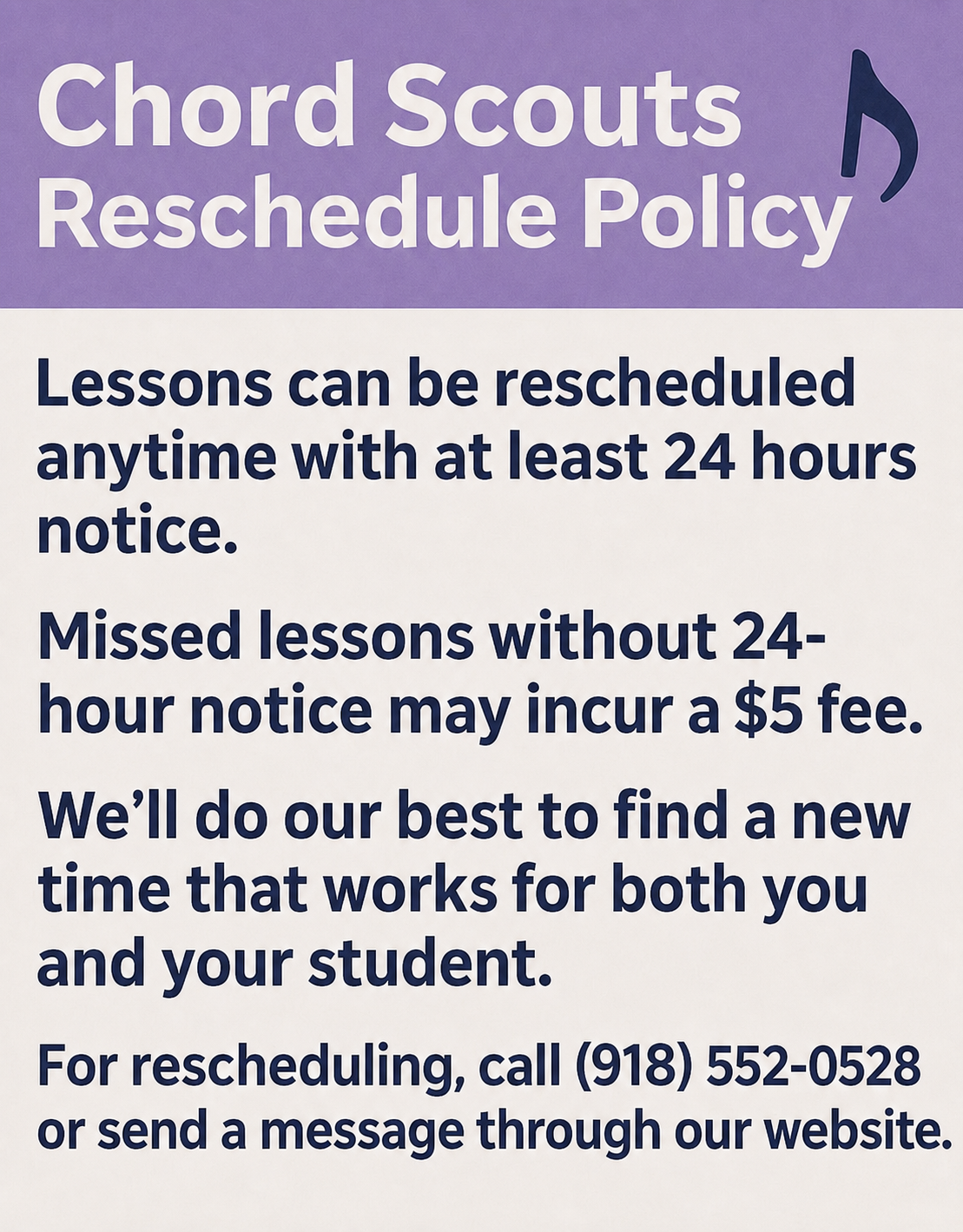
Chord Scouts reschedule policy

Please give at least 24 hours’ notice whenever possible. Open the policy image for a full-size copy.

Chord Scouts reschedule policy: lessons may be rescheduled with at least 24 hours notice; missed lessons without 24-hour notice may incur a five-dollar fee; call 918-552-0528 or message through the websiteOpen full size ↗